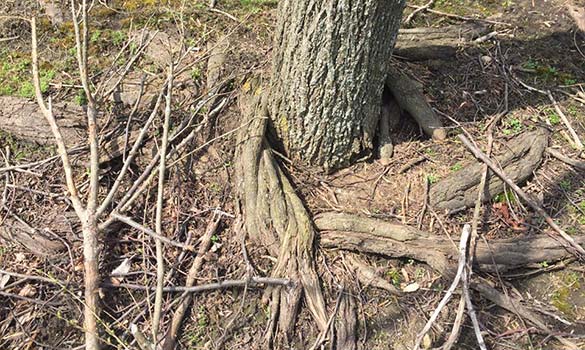
Trees in natural forest settings are highly self-sufficient. Leaf litter decomposes in place, returning nutrients to the soil. Mycorrhizal fungi networks extend the effective root zone. Soil biology is diverse and active. Urban and suburban trees rarely have any of these advantages.
Why Urban Trees Need Help
The typical residential tree is growing in compacted, often disturbed soil with poor structure. Leaves are raked and removed, breaking the nutrient cycle. Root zones are impervious surfaces, lawn, or mulch rather than native soil. Competition from turf and ornamentals is constant. These conditions make it difficult for trees to access the nitrogen, phosphorus, potassium, and micronutrients they need for healthy growth and resilience.
Nutrient-stressed trees are more susceptible to insects, disease, and environmental stresses. Regular fertilization is one component of a plant health care program that supports trees' natural defense systems and growth.
Soil Testing: The Right Starting Point
Before fertilizing, a soil test is valuable. It tells you what's actually deficient versus what's adequate, preventing over-application of nutrients the soil already has in abundance. Most Chicagoland soils are alkaline due to high calcium carbonate content from glacial deposits, which affects the availability of iron, manganese, and other micronutrients even when those nutrients are technically present in the soil.
Iron chlorosis — the yellowing of leaves between veins while veins stay green — is one of the most visible effects of nutrient deficiency in Illinois trees. It's particularly common in pin oaks, maples, and river birches in high-pH soils.
Deep Root Fertilization
The most effective fertilization method for established trees is deep root injection. A probe is inserted 8 to 10 inches into the soil at intervals around the tree's drip line (the outer reach of the canopy), and liquid fertilizer is injected under pressure directly into the root zone.
This approach has several advantages over surface applications:
- Fertilizer is placed where feeder roots are actively feeding — in the upper soil layers of the root zone
- Less fertilizer is lost to surface runoff
- The injection process also aerates the soil and can improve water infiltration in compacted areas
- Fertilizer formulations can be customized based on soil test results and specific tree needs
What's in the Fertilizer?
Professional tree fertilization programs use formulations specifically designed for woody plants — not the same as lawn fertilizer, which is high in nitrogen and can actually harm trees in the wrong proportion. Depending on soil tests and tree condition, formulations may include:
- Balanced NPK (nitrogen, phosphorus, potassium) ratios appropriate for woody plants
- Iron and manganese chelates for high-pH soils
- Mycorrhizal inoculants to support beneficial root fungi
- Humic acids and organic matter to improve soil structure and biology
More is not better with fertilizer. Excessive nitrogen drives rapid but weak shoot growth, diverts energy from root development, and can make trees more attractive to sucking insects. A measured, targeted approach based on actual soil and tissue analysis is always better than a general high-dose application.
When to Fertilize
The best times for tree fertilization in Northern Illinois are mid-spring (after leaf expansion is complete, when the tree is actively growing) and fall (after leaf drop but before ground freeze, when roots are still active). Fall fertilization is particularly effective because the fertilizer becomes available early in the following spring growing season.
Fertilizing in late summer or early fall before leaves drop encourages late-season growth that may not harden off before winter — generally best avoided.
If your trees seem to be growing slowly, showing undersized leaves, off-color foliage, or general lack of vigor, fertilization may be part of the answer. Contact Emerald Tree Care to discuss a plant health care evaluation for your property.