When a healthy-looking tree starts declining — thinning canopy, off-color foliage, die-back — the instinct is to look up. But very often, the cause is underground. Specifically, at the root collar: the flared area at the base of the trunk where roots originate.
What Is a Root Collar?
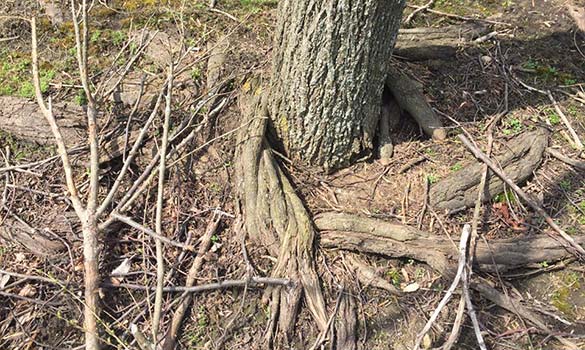
The root collar (also called the root flare or root crown) is the transition zone between the stem tissue of the trunk and the root tissue. In a healthy, properly planted tree, this zone is visible at or just above soil grade. You should be able to see the trunk flaring outward as it meets the ground.
The problem is that millions of trees across the Chicagoland area have their root collars buried — sometimes just an inch or two, sometimes 6 to 12 inches or more. This happens from improper planting depth, added mulch or soil over the years, or grade changes around the tree.
Why Burial Causes Decline
Trunk tissue is not designed to be underground. When buried, it stays persistently moist, which creates conditions ideal for pathogenic fungi and bacteria. Over time, the bark breaks down, decay enters the trunk, and the tree's structural base is compromised.
Just as damaging are girdling roots — roots that have grown in a circle around the trunk and are now constricting the flow of water and nutrients. Girdling roots are common when a tree is planted too deep or when roots encounter a container wall and continue growing in a circle rather than outward.
Signs That Root Collar Excavation May Help
- Declining canopy with no identifiable pest or disease cause
- Bark at the base of the trunk looks damp or discolored
- No visible root flare — trunk appears to go straight into the ground like a telephone pole
- Tree planted within the last 20 years (improper planting depth is very common)
- Soil, mulch, or debris piled against the trunk (volcano mulching)
- Progressively smaller annual growth increments
The Air Excavation Process
Root collar excavation uses an air spade — a tool that projects a concentrated stream of compressed air to move soil without damaging roots. Unlike hand tools or water, an air spade can safely expose the root collar area without cutting or tearing the roots you're trying to expose and protect.
Once the root collar is exposed, the arborist can assess what's there: How deep was the collar buried? Are there girdling roots? Is there existing decay? Corrective action is taken based on what's found — removing excess soil, carefully severing girdling roots, treating exposed wounds, and backfilling with appropriate material.
Root collar excavation is not a last resort — it's often most effective on trees that still have significant live crown. Trees in early to moderate decline often respond very well. The window for successful intervention closes as decline progresses.
The Results
When the root problem is identified and corrected, trees often respond with noticeably improved vigor within one to two growing seasons. The canopy fills in, leaf size returns to normal, and annual growth increments increase. For trees that have been declining for years without an identified cause, root collar excavation is frequently the answer that was hidden all along.
Ginger M. in Carol Stream captured the experience well: "the priceless education that comes with a full evaluation of the microclimate." Understanding what's happening underground changes everything about how you care for your trees.
If you have a tree that's been declining and you can't figure out why, contact Emerald Tree Care for an evaluation. We'll look at the whole picture — including below the surface.