
Trees rarely fail without warning. Most catastrophic failures — the ones that damage homes, cars, and injure people — involve defects that a trained eye could have identified weeks, months, or even years before the failure occurred. Knowing what to look for is the first step.
The following seven warning signs should prompt a call to an ISA-certified arborist. Not all of them mean the tree needs to come down — but all of them warrant a professional evaluation before the next major storm.
1. Cracks or Splits in the Trunk or Major Limbs
A crack in a tree trunk or major branch is not cosmetic — it represents a structural failure already in progress. Cracks can be the result of past branch failures, lightning, freeze-thaw cycles, or included bark giving way. A crack that is opening over time is especially urgent. Get it evaluated before it completes.
2. Co-Dominant Stems with Included Bark
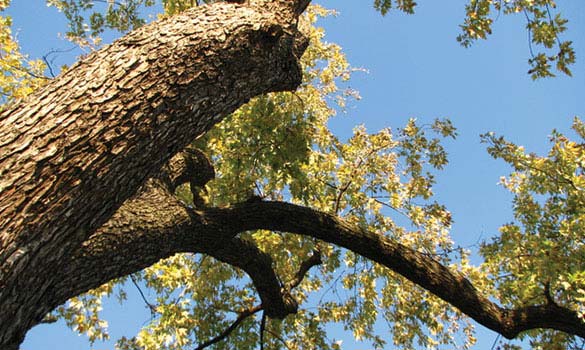
If your tree has two or more main stems of roughly equal size growing from the same point, look closely at the junction. If you can see bark embedded in the crease between the stems (it looks pinched and dark), that's included bark — a weak union with no solid wood connection between the stems. This configuration frequently fails.
3. Dead Branches in the Crown
A few dead branches are normal — occasional dieback happens even in healthy trees. But significant deadwood in the crown signals stress, and dead branches present a real hazard. They can fall at any time, often without wind as a trigger, and they tend to be more brittle and unpredictable than live branches.
4. Fungal Fruiting Bodies at the Base or on the Trunk
Mushrooms, conks, or shelf fungi growing from the base of a tree or along the trunk indicate internal decay — the fungi are the visible expression of an organism that's been feeding on the wood inside the tree. The presence of fruiting bodies means the decay is already advanced. How much sound wood remains needs to be evaluated by a professional.
5. Sudden Leaning or Ground Disturbance at the Base
A tree that has always leaned slightly is often stable — it has grown reaction wood to compensate. A tree that has recently started leaning, or where the soil at the base is heaving or cracking, is telling you that the root plate is compromised. This is an urgent situation, especially for large trees near targets.
Sudden lean is a high-urgency warning sign. If you notice a tree has shifted its lean, contact an arborist immediately — don't wait for your next scheduled maintenance visit.
6. Crown Dieback or Unusual Thinning
When a section of the crown dies back or the overall canopy appears significantly thinner than in previous years, the tree is telling you something is wrong. This can indicate root problems, girdling roots, soil compaction, vascular disease, or insect damage. Identifying the cause early determines whether the tree can be saved.
7. History of Severe Pruning or Damage
Trees that have been topped, experienced significant storm damage, or had large-diameter wounds from past limb failures may have extensive internal decay that's not visible from the outside. Whenever a tree has a significant injury history, periodic professional assessment is warranted to understand the current condition and trajectory.
What a TRAQ Assessment Involves
A formal Tree Risk Assessment follows ANSI A300 Part 9 and ISA Best Management Practices. A TRAQ-qualified arborist evaluates the tree, the site, potential targets, and the probability and consequence of failure to arrive at an overall risk rating. Recommendations range from monitoring to pruning, cabling, or removal, with a documented assessment you can reference.
David S. in Arlington Heights has it right: "[They] always provide a quote before performing any work." That starts with an honest assessment of what's actually going on with your trees. Contact Emerald Tree Care to schedule a tree risk assessment.